How a UAE Delegation Visited 3 New Energy Factories in Guangdong
A 4-person UAE delegation visited EVE Energy, Desay, and Haisida across Shenzhen and Huizhou — three factories, two cities, one mission. Here's what it took to pull it off, and what anyone planning a similar trip should know about the logistics.
Three Factories, Three Distinct Plays: What the UAE Delegation Actually Saw
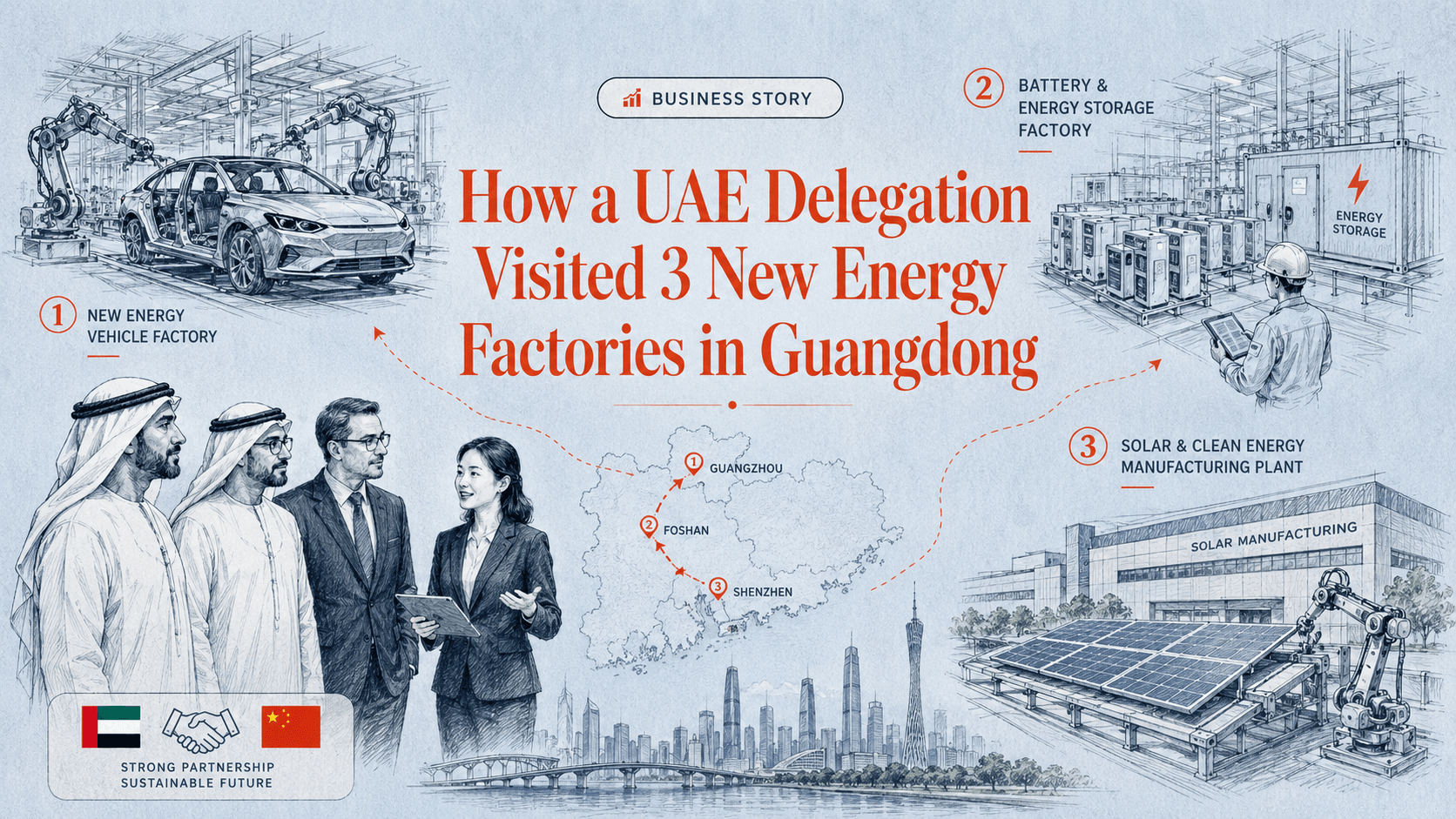
Four executives from the UAE spent three days visiting battery and new-energy manufacturers across Shenzhen and Huizhou — and the logistics held together because the transport was planned before anything else. If you're organizing a multi-factory due diligence trip in Guangdong, private driver service for factory tours in Guangdong handled this delegation's cross-city routing, and the model is repeatable for any group doing structured factory visits in the region.
They based themselves at the Four Seasons Shenzhen. Day 1: EVE Energy in Huizhou. Day 2: Desay, also in Huizhou. Day 3: two visits to Haisida, then straight to Shenzhen Airport. That's roughly 90 minutes of driving between most stops — enough time to lose a schedule if transport isn't locked in early.
The factories weren't chosen at random. Each one represents a different strategic play on which battery chemistry will dominate the next decade.
"For business visits, factory visits across Foshan, Shenzhen, hi-tech zone in Huizhou, or any manufacturing clusters in the Guangdong region, the service is very practical."
— Ilie, Head of Operations at China Car Rentals
This article walks through what the trip revealed — about the factories and the logistics.
What Is China's Battery Belt — and Why Does Guangdong Anchor It?
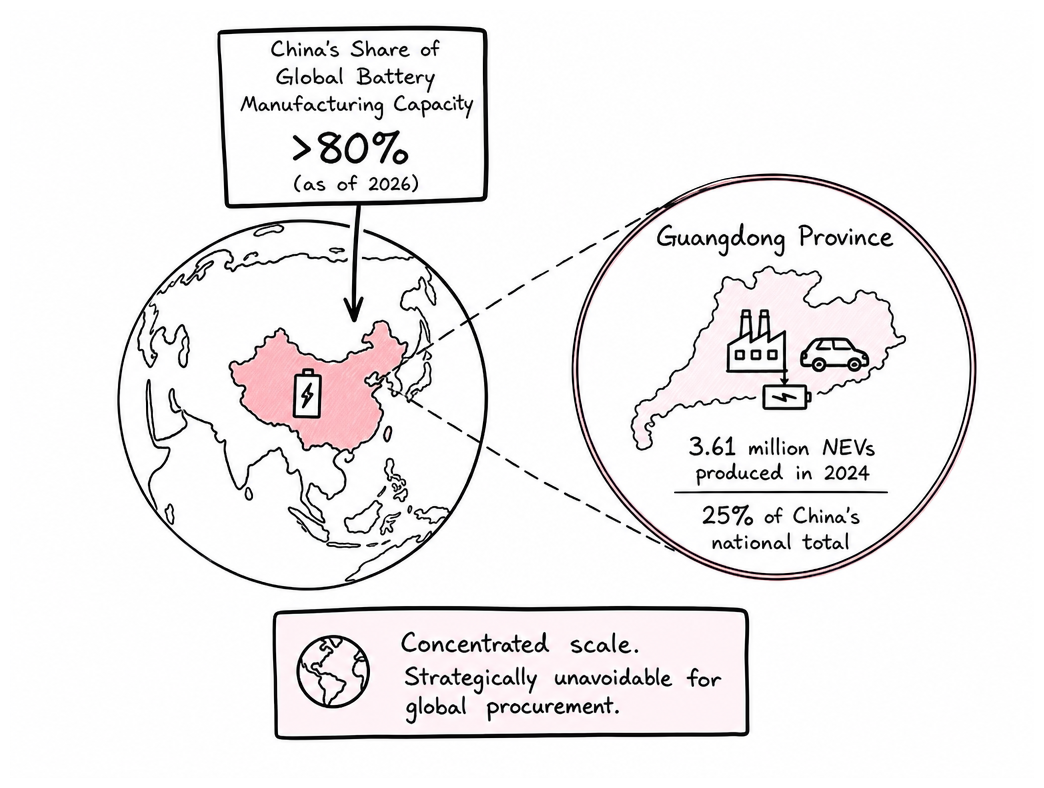
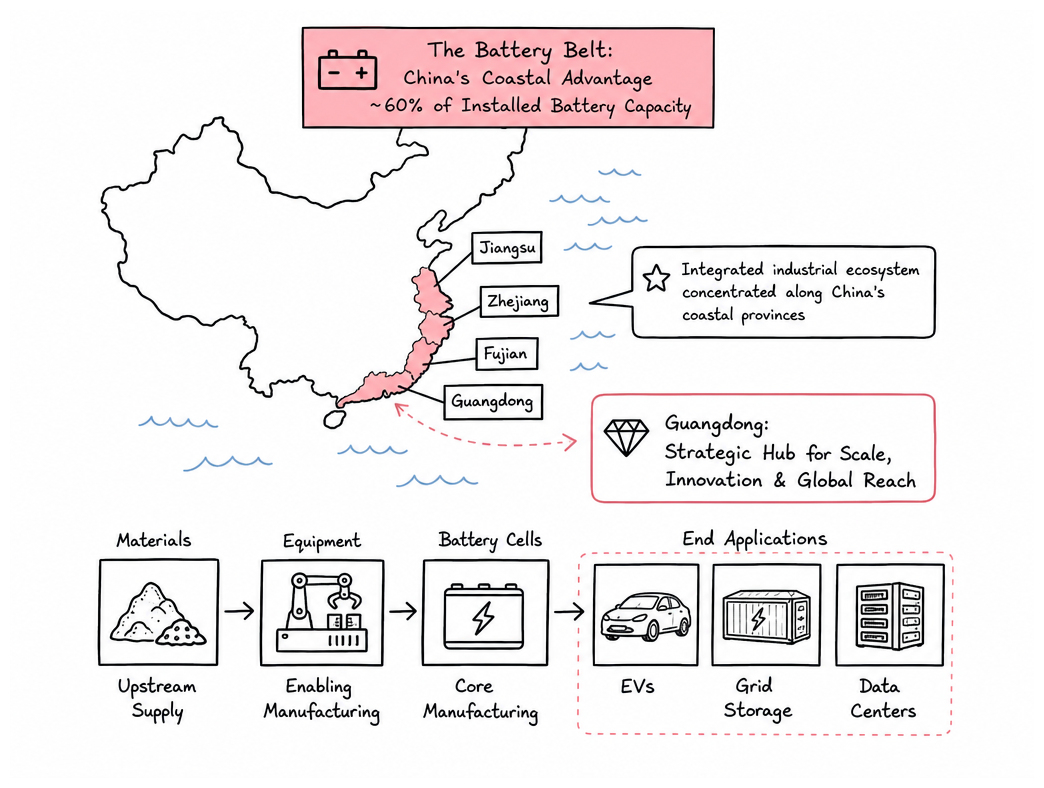
China produces over 80% of the world's battery cells. That production power sits in three main corridors: the Pearl River Delta (Guangdong), the Yangtze River Delta (Jiangsu, Zhejiang), and Central China (Hunan, Hubei). The "Battery Belt" isn't a marketing term — it's a geographic fact.
Guangdong is the southern anchor. In 2024, the province produced 3.61 million new-energy vehicles — roughly a quarter of China's national total — and its battery cluster generated 1.116 trillion yuan in revenue, according to official data. That's more of an economy than a niche cluster.
The practical upshot for delegation planners: Shenzhen and Huizhou sit inside the densest battery manufacturing corridor outside Jiangsu, as the IEA's Global EV Outlook 2026 confirms. That proximity is what makes a three-factory day achievable — but only if the transport between them is pre-engineered.
EVE Energy, Desay, and Haisida: The 3 Manufacturers That Made This Trip Worth Taking
Each factory represented a different technology approach. Here's what we walked into.
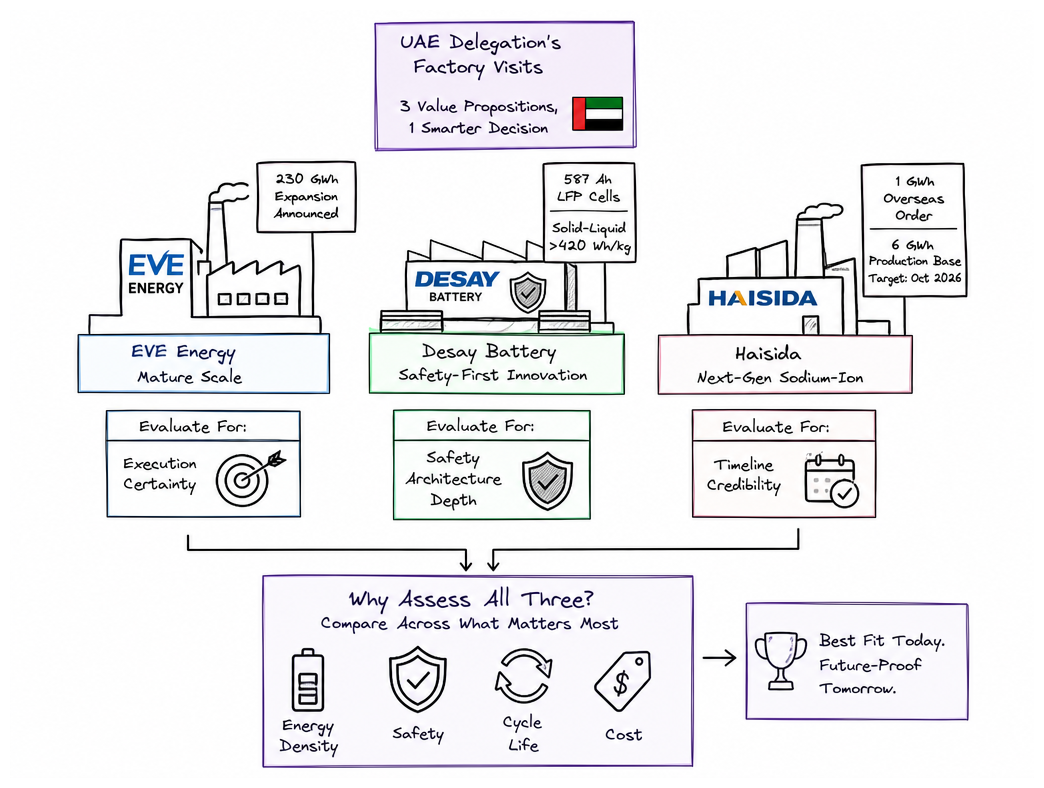
EVE Energy ranks 8th globally for EV battery installations with 31.3 GWh capacity and a 2.6% market share. The real headline: they're committing ¥6 billion for 60 GWh in Huizhou and targeting 230 GWh total expansion. Their Longquan No. 3 and No. 4 solid-state batteries launched in March 2026 — not prototypes, actual production. They're already embedded in Western supply chains through the Amplify Cell Technologies JV with Daimler Truck and PACCAR, and they power the new BMW iX3. This is what scale looks like when it's already inside your competitor's cars.
Desay SV generated $3.88 billion in revenue in 2024 and jumped 16 places on Automotive News' global parts supplier ranking. They hold 18.8% of the smart cockpit market — the integration layer most Western suppliers still haven't cracked. Their June 2026 alliance with Greencells signals they're moving into battery management systems, not just cell production.
Haisida is pushing sodium-ion into commercial territory. They secured a 1 GWh overseas order for 2025–2029 covering residential, commercial, and telecom applications, with a 6 GWh production base targeting October 2026. Sodium-ion is scaling fast — from 70 GWh globally today to roughly 400 GWh by 2030 at a 41.7% compound annual growth rate. More than 95% of that capacity sits in China. BYD already has a 30 GWh sodium-ion gigafactory online.
Three technology trajectories in one trip. That's not a factory tour — it's a due-diligence sweep across the full technology horizon.
What Does a Three-Factory Day in Shenzhen and Huizhou Actually Demand?
Guangdong's battery corridor is tighter than it looks. Three factories across two cities sounds manageable on a map, but the reality is 90-minute drives between stops, samples piling up after each visit, and industrial parks that don't appear on consumer GPS. Every hour you lose to logistics is an hour you're not evaluating suppliers — and in a market where deals move fast, that gap costs you.
Three things make or break the day: distance, cargo, and navigation.
Shenzhen and Huizhou sit 90 minutes apart by car. That's not downtime — it's either debrief time or lost time, depending on whether the route is pre-engineered. Factory visits generate samples, technical documents, brochures, and packaging. By stop two, a standard sedan's boot is full. The delegation chose a Mercedes Maybach V250L specifically for its long wheelbase — not luxury, but the practical reality of carrying materials across three stops without leaving anything behind. And industrial parks across Huizhou don't work like hotel driveways. A driver who knows the facility — who has been there before and understands the layout — eliminates the friction of unfamiliar grounds. That knowledge compounds across a full day.
The delegation pre-mapped the entire route before they landed. The driver knew each facility. The V250L handled the cargo. Day 3 brought the tightest timing — two visits to Haisida, then straight to Shenzhen Airport — and the schedule held because the transport was built around the itinerary, not the other way around.
Before you confirm a single factory appointment, lock in your vehicle and driver. Your schedule should flex around confirmed transport — not the reverse.
What Coordinating This Trip Taught Us About Delegation Logistics
Most delegations treat transport as the last thing they book. But when factory appointment windows are tight and the itinerary is already locked, the quality of your transport determines whether the trip runs on time or falls apart. The UAE team's brief was simple: no surprises, no missed windows. That outcome wasn't accidental — it was designed.
Three things made this trip work: speed of booking, transparent overmileage, and driver competence.
The client messaged on WhatsApp with city, dates, passengers, and vehicle type. An offer came back the same day. Payment confirmed the next morning. From first contact to confirmed booking: under 24 hours. That speed matters when factory windows are already allocated. Daily kilometer photos at the start and end of each day kept the overmileage transparent. A final invoice based on actual usage, not estimates. When the delegation finished their three-day circuit, the overmileage settlement happened instantly through a secure payment link. No disputes, no follow-up calls. And the driver — a licensed local who knew the factory locations, handled the security gates, and protected the schedule — is what let the principals focus entirely on the factories they came to evaluate.
The delegation didn't think about transport once during the three days. That was the point. When Day 3 required two Haisida visits before a Shenzhen Airport departure, the timing held — because the transport was pre-engineered, not improvised.
Message your transport provider first with city, dates, passengers, and vehicle type. Get the booking confirmed before you finalize factory appointments. That one sequence — driver first, schedule second — eliminates 80% of the logistics risk.
"The biggest challenge with factory visits in China isn't finding the suppliers — it's moving between them efficiently. A driver who knows the industrial parks, handles the gates, and protects your schedule is what turns three factory visits from a logistics headache into a productive day."
— Ilie, Head of Operations at China Car Rentals
What Goes Wrong When Transport Gets Booked Last?
When transport is an afterthought, the damage isn't just a late arrival. It's the evaluation quality that drops. Decisions get deferred. Follow-up questions don't get asked. The delegation came to assess three manufacturers — and if the commute drains energy, they're doing that assessment at 60% capacity. The real cost isn't the invoice. It's the focus your team loses before they ever walk through the factory gate.
Three consequences cascade when transport gets booked last: mismatched vehicles, unknown routes, and zero flexibility.
Book a standard sedan and by Day 2 your principals are juggling samples on their laps, documents in the lobby, and brochures on the floor. The vehicle choice directly affects meeting quality — comfort on a 90-minute inter-city leg isn't a perk, it's what lets principals show up sharp. A driver who doesn't know the industrial park layout adds friction at every stop. That friction compounds across a full day — lost minutes at each gate, wrong turns between facilities, stress that bleeds into the next meeting. And factory schedules shift. Meetings run long. If your transport can't flex with the itinerary, one overrun cascades into the next appointment. The delegation's Day 3 required two Haisida visits before a Shenzhen Airport departure — if the driver hadn't known the facility and the airport lead times, that schedule collapses.
The fix is simple: book the driver first, then build the factory schedule around that confirmed booking. Your factory times should flex around a locked-in route, not the other way around. Multi-stop itineraries across Shenzhen and Huizhou demand cross-city routing expertise that generalist platforms can't deliver.
When you're planning your next multi-factory trip, do this before anything else: message a dedicated chauffeur service with your city, dates, passenger count, and vehicle preference. Get the booking confirmed. Then — and only then — lock in your factory appointments around that transport. One domino: driver first, schedule second. Everything else follows.
How to Plan a Guangdong Factory Visit Route That Actually Holds Together
Booking transport last and ending up with transport that doesn't work — I see it all the time, but seriously, it's so important to plan transport first, then schedule the visits and other busy-ness around it. Otherwise, you get principals who arrive drained from the travel. Here's how to flip that.
- Organize by geography first. Plan your Shenzhen day separately and span Huizhou across a few consecutive days. Mixing the two on the same day wastes several hours on the road with zero due-diligence payoff. Remember that you can't recover lost drive time in a factory meeting room.
- Expect navigation time at industrial parks. Battery manufacturing plants require you to check in, get an escort, and navigate through the estate to reach the actual facility. This process takes longer than you'd expect — build buffer time into each stop so one delay doesn't cascade through the rest of your day.
- Match vehicle to the mission. If your goal is to bring back product samples or tech docs, you need boot space. It's not just optional, or negotiable — you can't do without it. If you're bringing back samples, don't opt for a tiny compact sedan or anything that won't hold everything. Pick your vehicle before confirming factory tours.
- Verify overmileage policy. To avoid disagreements on final invoices, proactively find out about overmileage policies and note them down upfront in writing. A transparent daily kilometre record (as used on this trip) prevents billing friction when you're home. Ask your transport provider to lock it in the booking. No surprises on the final invoice.
- Lock in your driver first, then finalize factory schedule. Factory times should cater to a confirmed driver, not the other way around. Having a locked-in driver means you get a locked-in route.
When these five elements are mastered your principals will be sharp & ready — not scrambling to get to their locations on time.
What the UAE Delegation's Trip Signals for Anyone Watching the Battery Belt in 2026
When logistics are set, you get the story. When a Gulf capital does three-factory due diligence in Guangdong in one trip, it's a structural signal. Global battery-investment decisions are being made increasingly on the ground in Guangdong, not in boardrooms thousands of miles away.
The scale backs this up. Guangdong's new energy industry cluster saw operating income top 1 trillion yuan in 2024 — the ninth trillion-level industrial cluster in the province. And sodium-ion is no longer theoretical. The IEA's February 2026 analysis confirms that nearly all existing global sodium-ion manufacturing capacity sits in China, which accounts for more than 95% of 2030 capacity. CATL has confirmed commercial-scale deployment starting in 2026, and Haisida's 1 GWh overseas order is already in motion.
So here's the practical takeaway for you: whether you're running due diligence on battery chemistry or scoping a supply partnership, the trip only works if ground logistics hold. From the first factory gate to the departure terminal, every link matters. Preparation quality is the bottleneck, not access — the transport and logistics infrastructure for factory visits in Guangdong is mature and well-established.