Getting Around Guangzhou: A Foreigner's Guide (2026)
You can't self-drive in Guangzhou — but you've got three solid options. Here's what each one actually looks like in 2026.
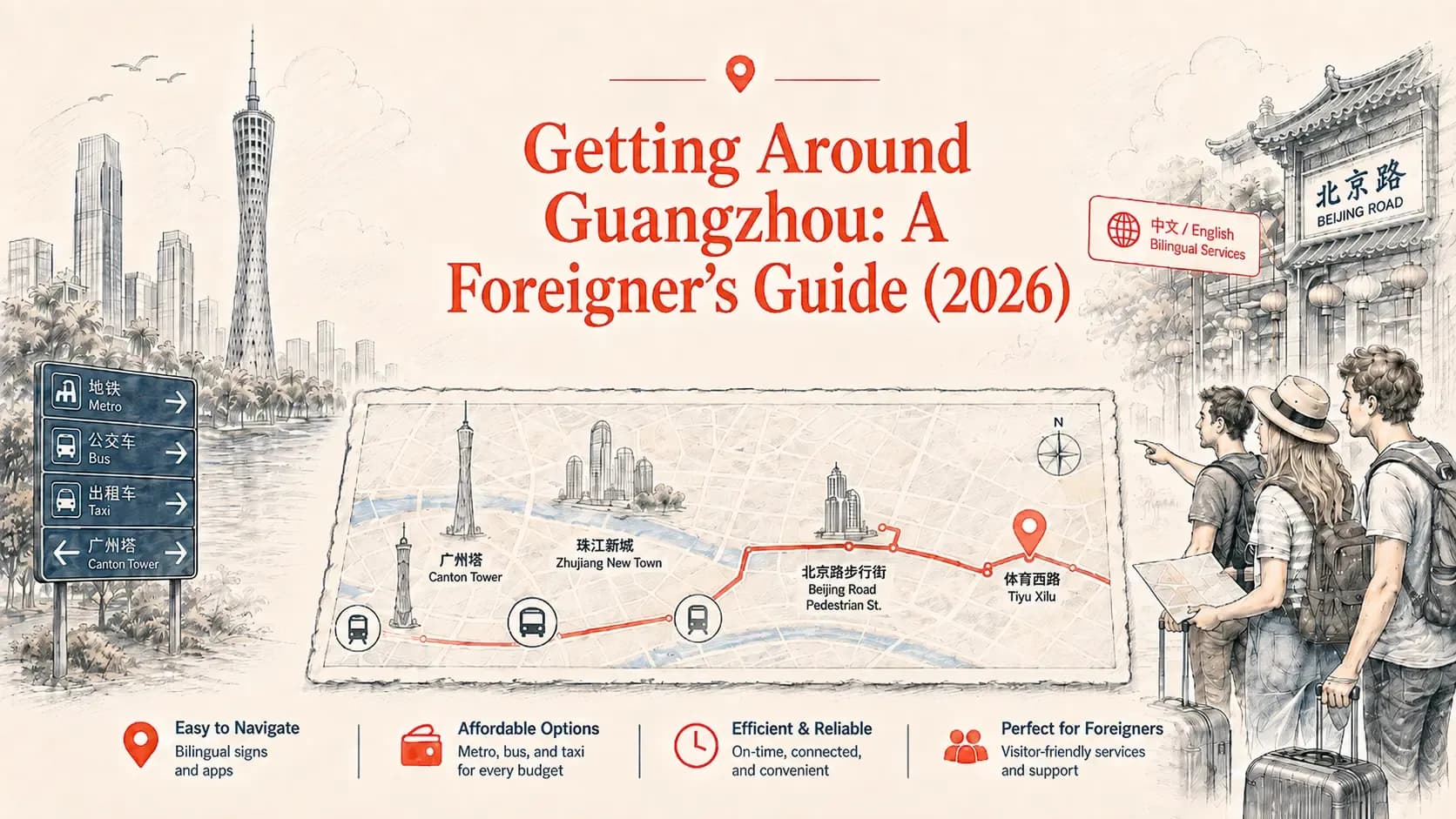
Getting Around Guangzhou: The Short Answer
Foreigners can't self-drive in Guangzhou — China doesn't recognise international driving permits, and self-drive rental platforms require a Chinese license you don't have. Your real options are public transit (metro, buses), ride-hailing apps like DiDi, or booking a chauffeur through a local service. Metro works for single stops in the city center. DiDi works for quick rides once you've solved the setup friction. A private driver works best for multi-stop business days, factory visits across Guangdong, or cross-border trips to Hong Kong and Macau.
This guide breaks down what each option actually looks like in practice — not the marketing version, but the version you discover once you're on the ground.
"When you Google "rent a car china", results like Kayak, Trip.com and other sites are the best places to go for a rental, but those search results are for self-drive vehicles, when in reality Chinese car rentals for foreigners can only be rented with a driver."
— Ilie, Head of Operations at China Car Rentals
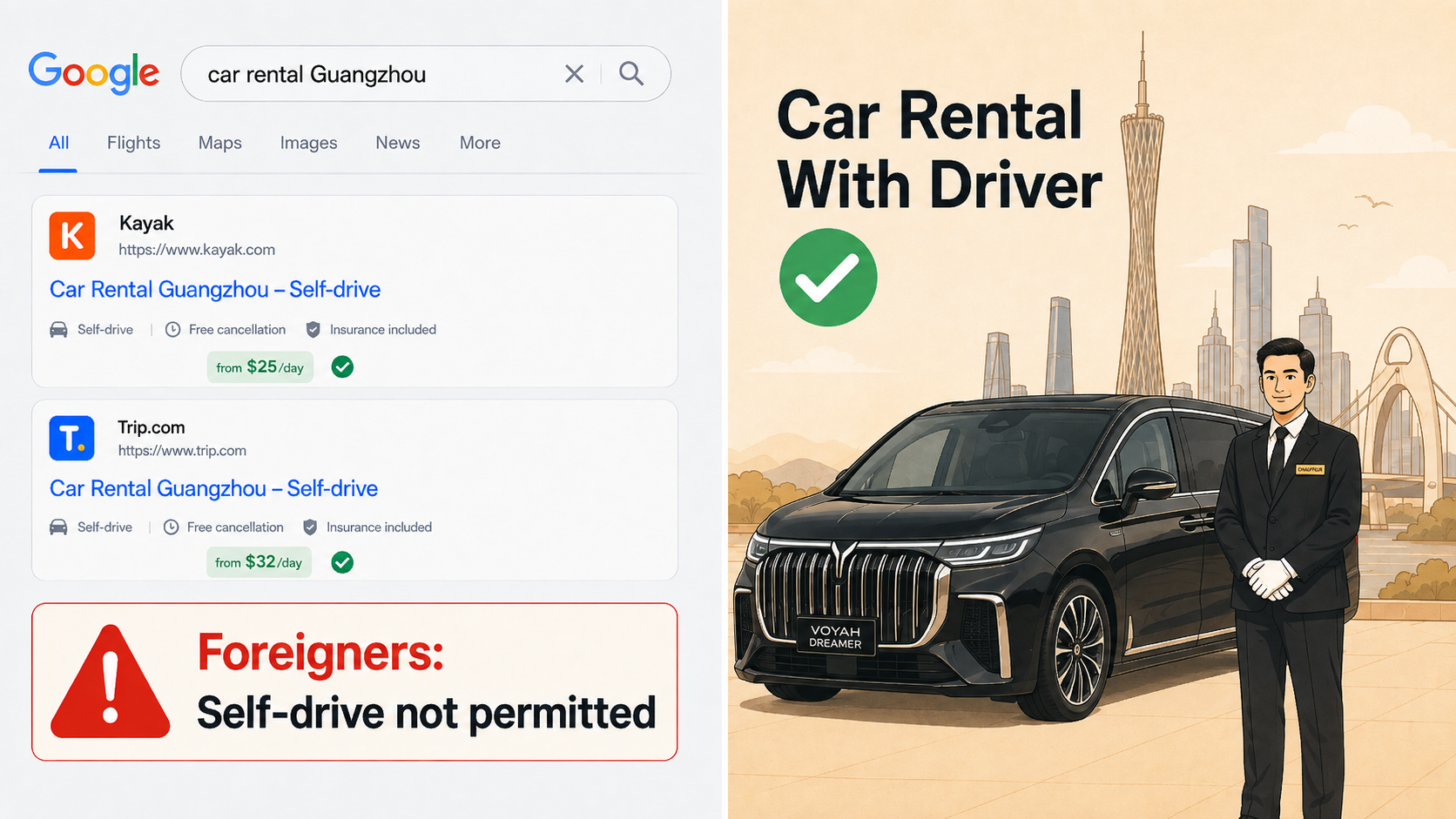
Googling "car rental Guangzhou" in 2026 returns the same results it did three years ago: Kayak, Trip.com, a handful of aggregators — all showing self-drive options with prices that look too good to be true. They are. What these platforms don't make clear is that a foreign visitor cannot legally drive a rental car in China without a Chinese driving license, which means the entire self-drive market is invisible to you the moment you land.
China welcomed over 68 million international visitors in 2025, a 15.5% year-on-year increase, and the trend is continuing into 2026. More foreigners are arriving, and more of them are hitting the same wall: search shows self-drive options, reality requires a driver.
That disconnect — between what search shows and what's actually available — is the starting point for figuring out how to move around Guangzhou. You've got three real options, and each has its place. The right one depends on where you're going, how many stops you have, and whether you're travelling light or coordinating a full business day across multiple cities.
Why You Can't Just Rent a Car and Drive
China hasn't signed any International Driving Permit conventions. That's the core issue. Your home license and any IDP you hold have no legal standing here. The result is simple: self-drive rental platforms like Kayak and Trip.com show you available cars, but you can't actually book one without a valid Chinese driving license.
There's a workaround — foreigners can apply for a temporary Chinese driving permit from their local traffic police department. Depending on your visa, it's valid for three months to a year. But the process is entirely in Chinese, requires an in-person visit to a government office, and takes time most visitors don't have. For a short business trip or a week of factory visits across Guangdong, it's not practical.
Which means, practically, self-driving is off the table for nearly every foreign visitor. With 35.17 million foreign tourists arriving in China in 2025 (excluding Hong Kong, Macau, and Taiwan), and that number growing in 2026, millions of visitors are hitting this same wall every year. The options that actually work are public transit, ride-hailing, or a private driver. The question isn't whether you can drive — it's which of these three fits the way you're travelling.
Public Transit in Guangzhou: What Actually Works in 2026
Guangzhou's metro is one of the most foreigner-friendly transit networks in China. Since October 2025, the entire system accepts contactless Visa, Mastercard, JCB, and Amex cards — tap at the gate and go. No app, no Chinese ID, no registration. Fares run ¥2–10 depending on distance.
For longer stays, the Yang Cheng Tong card is worth picking up. Buy one at any metro station with your passport (¥20 refundable deposit, then load credit). It works across metro, buses, trams, and ferries — with tiered discounts: no extra discount below ¥80/month, 20% off the ¥80–200 portion, and 50% off above ¥200.
The catch: buses and trams still don't accept foreign card taps. You'll need either the Yang Cheng Tong card or a WeChat Pay/Alipay QR code for surface transport.
Here's the honest assessment: public transit works well for single-destination trips within the city center. Travelling light, time to spare, straightforward stops — the metro is fast and cheap. But coordinate multiple meetings across business districts, or head to factory visits in Foshan or Shenzhen, and transit times add up fast.
Does DiDi Actually Work for Foreign Visitors?
The short answer is yes — and it's gotten significantly easier since 2026. DiDi now offers a full English interface and accepts international credit cards directly, which means the old workarounds (WeChat Pay wallets, Chinese SIM cards) are mostly Optional rather than mandatory.
DiDi dominates China's ride-hailing market with roughly 70% market share across 400+ cities. You can register with an international phone number, switch the app to English, and pay with your home credit card.
That said, a few things still trip people up:
Registration. International numbers work, but verification codes don't always come through first try. Register before you arrive — ideally at the airport or your hotel, not while standing on the curb.
Address input. Destinations still need to be entered in Chinese characters for most rides. The practical fix: save your destinations in advance, or have your hotel concierge write them for you.
First-ride prepayment. Some users still report foreign cards being blocked for the initial prepayment. If this happens, adding WeChat Pay or Alipay to your DiDi account resolves it.
Once set up, DiDi works well for short, single-stop rides around the city. A quick hop from your hotel to a meeting in the same district? DiDi gets it done.
But that's where its utility plateaus. Multiple stops across business districts? Factory visits outside Guangzhou — Foshan, Shenzhen, Huizhou's hi-tech zone? DiDi doesn't handle those well.
For a single errand in the city center, DiDi is a solid choice. For anything beyond that, you'll want a private driver.
When Does a Private Driver Actually Make Sense?
Guangzhou isn't a point A to point B kind of city. It spans seven business districts, spread roughly 20–40 kilometers apart. Tianhe CBD to Haizhu's exhibition zone is 15km. Zhujiang New Town to Yuexiu's wholesale markets is 10km. Nansha port to Tianhe is 50km. When you're bouncing between meetings across multiple districts, the time lost to hailing separate rides, waiting for pickups, and navigating between apps adds up fast.
That's where a private driver changes the equation — not as a luxury, but as a time-saver.
"With a private driver, you can accomplish an entire day's worth of meetings, factory visits, and sightseeing — all while enjoying the comfort of the car and taking in Guangzhou's unique views between stops."
— Ilie, Head of Operations at China Car Rentals
The fleet ranges from internationally recognised models like the Mercedes V-Class, Toyota Alphard, and Maybach to Chinese premium alternatives like the Voyah Dreamer, BYD, Buick GL8, Zeekr, and Maextro S800 — all under four years old. You're not just moving between locations; you're working, resting, or watching the city shift from Pearl River New Town to Haizhu's skyline.
But the real value shows up in specific scenarios. During the Canton Fair, over 200,000 international buyers descend on Pazhou Complex, and surrounding roads slow to a crawl. If you're attending the fair, this guide covers how to navigate Canton Fair transport without the headaches.
Multi-stop factory days across Guangdong — Foshan, Shenzhen, Huizhou — are another case where a single car with a fixed itinerary eliminates the friction of coordinating multiple rides. And if you need translation support or business logistics handled during the day, that's included in the service.
China Car Rentals runs this through WhatsApp, with live agents who respond contextually to your specific trip — not web forms, not call centers. You share your dates, passenger count, and itinerary; they match you to the right vehicle and confirm your booking before you meet your driver.
For cross-border trips — Guangzhou to Hong Kong or Macau — the driver handles all permits and border paperwork. You don't walk luggage through checkpoints. The vehicle and route are licensed for the crossing.
A private driver isn't always the answer. But when your day involves multiple stops, tight timing, or travel outside the city, it's the option that doesn't leave you managing logistics while you should be managing your business.
How Does Booking a Private Driver in Guangzhou Work?
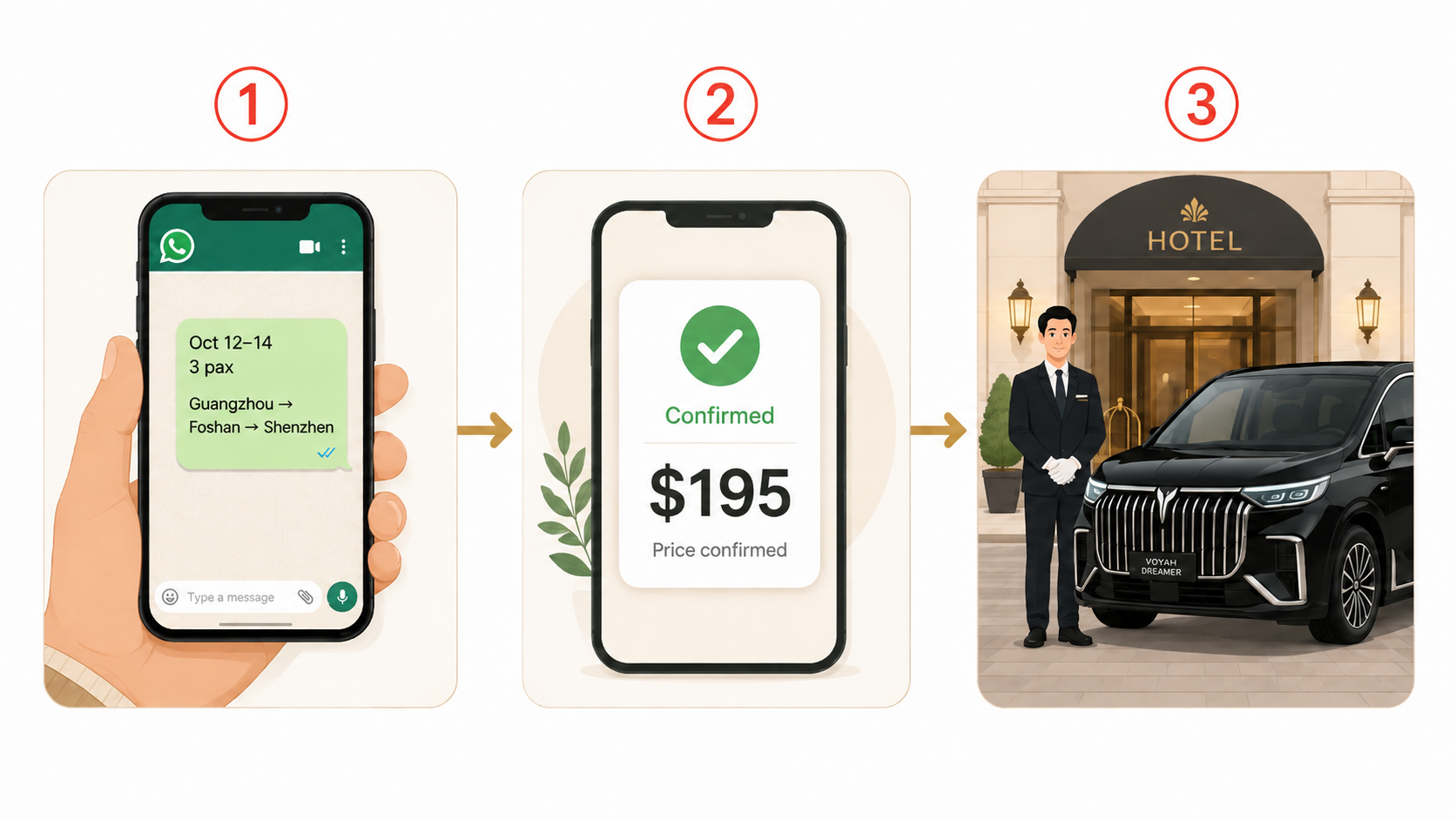
The process is deliberately simple — three steps, no forms, no call centers.
1. Message your details on WhatsApp
Share your dates, number of passengers, luggage, and destinations. A live agent reads what you wrote and responds directly — not a chatbot, not a template. If you're planning multiple stops, they'll walk you through vehicle options.
2. Confirm your rate and pay
Pricing is fixed and agreed before you travel:
Service | Rate |
|---|---|
Baiyun Airport pickup with meet & greet | From $95 |
Full day (8 hrs, 100km) | From $195 |
Cross-border to Hong Kong or Macau | From $395 |
3. Meet your driver
Your driver arrives at your hotel or pickup address, briefed on your full itinerary and monitoring live traffic. They know which departure window gets you to your first stop on time, and they adjust the route in real time as conditions change.
It's a concierge car service — not a taxi, and not a ride-hailing app where you're explaining your destination to a stranger in real time. The difference matters when your day has structure.
Which Option Should You Actually Use?
The right choice depends on the shape of your day. Here's how the three options compare:
Option | Best For | Cost | Multi-Stop | Setup Required |
|---|---|---|---|---|
Metro/Bus | City-center hops, flexible timing, light luggage | ¥2–5 per ride | No | Tap card at gate |
DiDi | Quick single rides once app is configured | $5–15 | Yes - but not at your disposal | Download app |
Private Driver | Business days, factory visits, airport, cross-border | $95–395/day | Yes | WhatsApp message |
Public transit works when you're travelling light, and your schedule is flexible. Single stops, no luggage, time to spare. The metro is fast and cheap — use it.
DiDi makes sense for spontaneous single rides once you've solved the setup. A quick hop from your hotel to a meeting in the same district? DiDi gets it done.
A private driver earns its place when the day has structure. Multiple stops across business districts. Factory visits in Foshan or Shenzhen. Canton Fair logistics. Airport transfers where timing matters. Cross-border trips to Hong Kong or Macau. The more stops, the tighter the schedule, and the heavier the luggage — the more a private driver pays for itself.
None of these options is universally "best." But if you're in Guangzhou for business and your day involves moving between multiple locations with purpose, a private driver is the one that lets you focus on the work instead of the logistics.
And if you're still deciding, start with the question that matters: how many stops do you have today? If the answer is more than two, you already know which option makes sense.